Loading Design... please wait.।
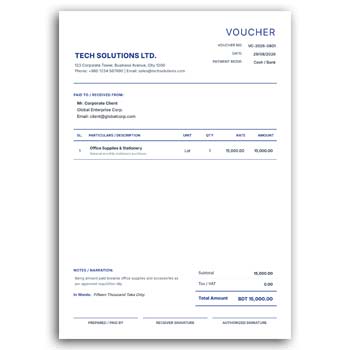
Voucher Format Design Editable
A voucher is commonly used to document a business transaction, payment, receipt, expense, or other financial activity. Keeping these records in a clear format can make everyday office administration much easier.
A Voucher Format Design Editable gives you a prepared structure that can be customized for different types of transactions. Instead of building a new document every time, you can update the relevant information and prepare a professional-looking voucher quickly.
Start With a Ready-Made Structure
A well-organized voucher can bring important transaction details together in one place. Depending on its purpose, it may include a voucher number, date, description, amount, payment information, and authorization details.
The editable nature of the format allows you to adjust these sections according to your business requirements. This makes the same basic design useful for different situations.
Key Things You Can Customize
- ✓ Enter voucher number and transaction date
- ✓ Add payer or recipient information
- ✓ Describe the transaction clearly
- ✓ Enter amount and payment details
- ✓ Add company name and logo
- ✓ Include signature or approval areas
- ✓ Modify available text and layout elements
- ✓ Reuse the format for future transactions
Advantages and Limitations
| Advantages | Limitations |
|---|---|
| ✓ Makes transaction records more structured | • Required fields may vary by organization |
| ✓ Reduces repetitive document preparation | • Incorrect financial information can cause issues |
| ✓ Can be customized for different purposes | • Some transactions may require supporting documents |
| ✓ Easy to reuse for regular office work | • A template does not replace accounting policies |
| ✓ Provides a clear reference for payments | • Additional tax or legal fields may sometimes be necessary |
| ✓ Suitable for digital and printed records | • Final documentation should be reviewed before use |
What Can a Voucher Be Used For?
The exact purpose of a voucher depends on the organization. It may be used to record payments, expenses, receipts, cash transactions, or other approved financial activities.
Some businesses maintain separate formats for different transaction types. An editable design can be modified to fit the particular workflow instead of forcing every activity into one rigid structure.
Add the Transaction Details
The central part of a voucher should explain what the transaction is about. You can include a short description, reference number, date, amount, and other information relevant to the payment or expense.
Clear descriptions make later review easier. Someone checking the document should be able to understand the basic purpose of the transaction without needing unnecessary clarification.
Make the Amount Easy to Identify
Financial figures should be presented clearly. Depending on the voucher type, you may include the amount in numbers and words, along with any applicable deductions or additional charges.
A separate total section can make the final amount easier to locate. Always verify calculations before the voucher is finalized.
Add Authorization Information
Businesses often have internal approval procedures for payments and expenses. An editable voucher can include areas for the person preparing the document, checking it, and approving the transaction.
The exact roles will depend on the organization’s accounting process. You can customize the available fields to reflect your own approval structure.
Useful for Regular Office Transactions
A voucher can become particularly useful when an organization handles many small financial transactions. Instead of relying on informal notes, employees can record the information using a consistent format.
This can help accounts and administration teams maintain more organized documentation. It also makes previous transactions easier to reference.
Related Conveyance Documents
Transportation expenses are another area where structured financial documentation can be useful. For example, a Conveyance Bill Format can help organize official transportation claims.
If you need a document specifically prepared for PDF-based record keeping, you can also explore this Conveyance Bill Template.
For office-based employee travel expenses, an Office Conveyance Bill can provide another useful format.
Personalize the Business Information
A voucher should identify the organization responsible for the transaction. You can add the business name, address, contact details, logo, or department information where appropriate.
Using consistent branding across financial documents can make office records look more professional. It can also help distinguish your company’s documents from unrelated paperwork.
Keep the Layout Practical
Financial forms should prioritize readability. Important information such as the transaction description, amount, date, and authorization should not be hidden among unnecessary design elements.
A clean layout with clearly labeled sections can make the voucher easier to complete and review. This is especially helpful when several vouchers are processed every day.
Use the Same Format Again
Once you have a suitable voucher layout, there is little reason to redesign it for every transaction. Keep a master version and create a new copy whenever another voucher is required.
Only the transaction-specific information needs to be updated. This can save time while maintaining a consistent documentation style.
Digital Record Keeping
Editable vouchers can fit well into a digital office environment. Employees can complete the document electronically and send it to the appropriate person for review or approval.
Completed vouchers can then be stored with other financial records. This may make searching and organizing transaction documentation easier than relying entirely on physical paperwork.
Printed Documentation
Some businesses still maintain physical financial records. In such cases, a completed voucher can be printed and signed according to the organization’s internal process.
Before printing, check the transaction date, amount, description, names, and authorization information. A quick review is especially important for documents containing financial figures.
What Information Is Normally Included?
There is no single universal voucher format for every business. Depending on the purpose, a voucher may contain a voucher number, date, transaction description, amount, payment method, recipient information, and signatures.
Some organizations may also require account codes, tax details, supporting document references, or approval notes. The editable structure can be adjusted to accommodate these requirements.
Voucher Design for Different Organizations
Small businesses, corporate offices, NGOs, educational institutions, shops, and service providers may all have different documentation needs. An editable voucher allows the basic structure to be adapted rather than recreated.
For example, a small business may need only a few simple fields, while a larger organization may require several approval stages. The format can be adjusted accordingly.
General Financial Documentation
Vouchers are part of a broader system of financial record keeping. Businesses often use them alongside invoices, receipts, purchase orders, expense claims, and other accounting documents.
For general information about accounting records and vouchers, you can explore Accounting on Wikipedia.
Design Inspiration for Professional Forms
Good financial documents do not need excessive decoration. Clear typography, logical spacing, organized tables, and a consistent visual hierarchy can make a form easier to use.
If you want additional ideas for creating professional editable business documents, explore Business Form Templates for different layout concepts.
A Quick Way to Prepare a Voucher
Begin with the editable format and enter the company information. Add the voucher number, date, transaction description, amount, and any required payment details.
Complete the approval or signature sections and review all financial information. Once everything is correct, the voucher can be saved, shared, printed, or stored according to your normal workflow.
Why an Editable Voucher Format Is Useful
The main benefit is convenience without losing structure. You get a prepared layout while retaining the ability to change the information needed for each transaction.
For organizations that create similar financial documents regularly, this can reduce repetitive administrative work. It can also help maintain a consistent appearance across records.
Final Thoughts
A Voucher Format Design Editable can provide a simple and flexible way to document payments, expenses, receipts, and other business transactions. The format can be personalized with transaction information, company branding, amounts, descriptions, and approval fields.
Whether you use vouchers for daily office expenses or broader financial documentation, a reusable editable format can make the process more organized. Always review the completed document carefully and adapt it to your organization’s accounting procedures and applicable requirements.
2 Comments
2 Pingbacks